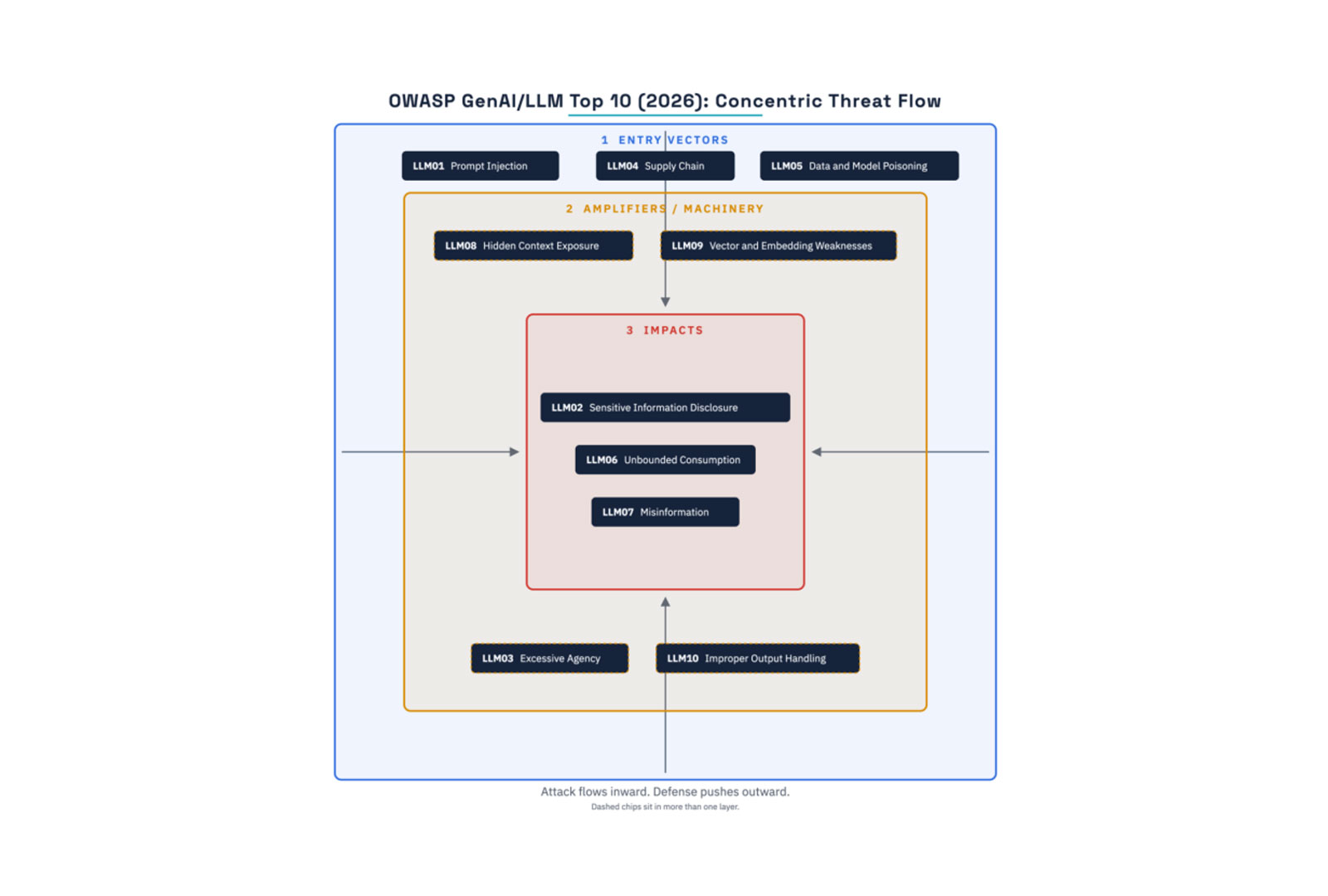
A week ago, OWASP released the first version of their Top 10 for LLM Applications 2026 whitepaper. My first thought: finally — an official, comprehensive recommendation on AI security.
What is it?
The OWASP Top 10 for LLM Applications 2026 is a guide to the most critical security risks facing applications powered by large language models.
Think of it as the classic OWASP Top 10 for web security — but built specifically for the AI/LLM era.
Like the technology it covers, this list is a product of the community. It has been shaped by developers, data scientists, and security practitioners who brought their judgment and, this year, their incident records to the work.
The guide covers:
- Descriptions — a precise technical explanation of each risk, including all the ways it can surface, not just the obvious ones.
- Common examples of Risk of the most critical LLM application risks.
- Example attack scenarios with actionable mitigations for each risk.
- Prevention and Mitigation Strategies — concrete, actionable steps for each risk, mapped to industry frameworks.
Who is it for?
The whitepaper is written for a wide audience:
- Developers, architects and end-users building LLM-powered applications
- Security teams who need to assess and harden AI systems
In short: if you work in IT and AI touches your work in any way, this is for you.
What changed from 2025 to 2026?
The order moved more than in previous years, and the moves reflect the gap between what practitioners believed was risky and what the incident record actually confirms.
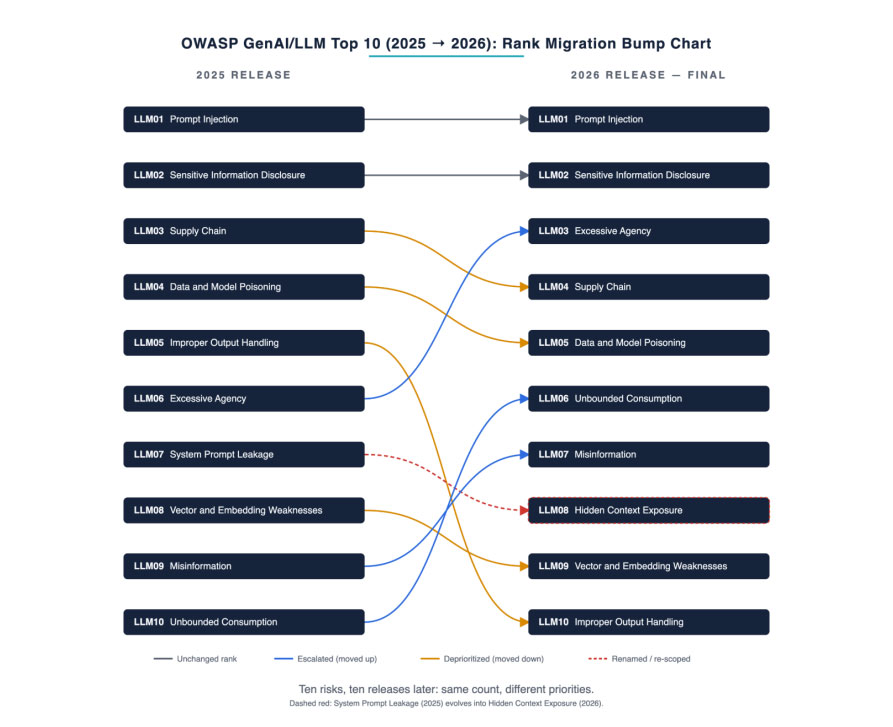
The most notable shifts:
- Excessive Agency climbed to #3 — the biggest move on the list. Both the community vote and real-world incidents agree: agentic deployments are where damage is landing.
- Unbounded Consumption rose four places — practitioners now weigh resource and cost exhaustion more seriously than before.
- Improper Output Handling fell the furthest — from #5 to #10.
- Prompt Injection held #1, and Sensitive Information Disclosure held #2 — the one spot where belief and evidence simply agree.
- System Prompt Leakage was renamed to Hidden Context Exposure — a broader framing for the same underlying failure: trusting information that should never have been reachable.
Several entries also grew in scope. Prompt Injection now covers cross-modal attacks — instructions hidden inside images or audio. Supply Chain now accounts for the trust failure when a model artifact is not what it claims to be. Data and Model Poisoning now absorbs fine-tuning subversion. Improper Output Handling now spans the insecure code that LLM assistants generate at scale.
One boundary also became clearer with this release. This list covers the risk when the model is a component inside your application. The moment that model becomes an actor — with tools, memory between sessions, and downstream consequences — the risk moves to the OWASP Agentic Top 10. Neither list covers that ground alone.
Summary
“Stop trying to build a model that cannot be fooled. Build the system around it, so that when the model is fooled, and it will be, nothing important breaks.”
— Letter from the Project Leads, OWASP Top 10 for LLM Applications 2026
The AI landscape is evolving fast — and so are the attack surfaces. Having a structured, community-backed security guide is exactly what the industry needs right now. Whether you are building LLM-based products or managing the security of AI-integrated systems, reading this whitepaper is time well spent.
I encourage everyone in IT to read it. It is available for free — there is no reason to skip it.